


14 minutes read

The 8 best GoDaddy alternatives in 2026 are JetHost, SiteGround, Bluehost, Hostinger, Namecheap, DreamHost, Cloudways, and Hosting.com.
GoDaddy is the world’s largest domain registrar and a genuine one-stop shop for domains, hosting, email, and site tools. For site owners who want everything in one place, that convenience has real value. However, the tradeoffs become visible after the first term.
User reviews reveal three consistent issues:
- renewal prices that rise roughly 2.5 times the introductory rate
- a hosting refund window cut from 30 to just 7 days
- checkout flows that silently auto-enroll add-on services
If you are searching for the best alternatives to GoDaddy, the eight providers below address exactly those gaps.
What Are the Best GoDaddy Alternatives in 2026?
Here are the top GoDaddy alternatives in order:
- JetHost: Best overall. Human expert support, managed WordPress tools, Patchstack protection, and free unlimited migration.
- SiteGround: Best for managed shared hosting with strong security and daily backups.
- Bluehost: Best for beginners who want a guided setup experience with a free domain.
- Hostinger: Best for budget-conscious users who need low entry pricing and AI site tools.
- Namecheap: Best for domain buyers and price-sensitive site owners who want cPanel.
- DreamHost: Best for WordPress users and developers who want a 100% uptime guarantee.
- HostGator: Best for small businesses and bloggers who want an established cPanel host with unmetered bandwidth and AI site creation tools.
- hosting.com: Best for speed-focused users who want LiteSpeed infrastructure and cPanel.
Finding the best alternative means looking past name recognition to what each host actually delivers. The rival GoDaddy hosting providers were ranked across four axes: performance stack, pricing transparency, ease of use, and support quality.
The sections below break down what makes each of these the best alternatives to GoDaddy for different use cases.
1. JetHost: Top Recommended Alternative to GoDaddy
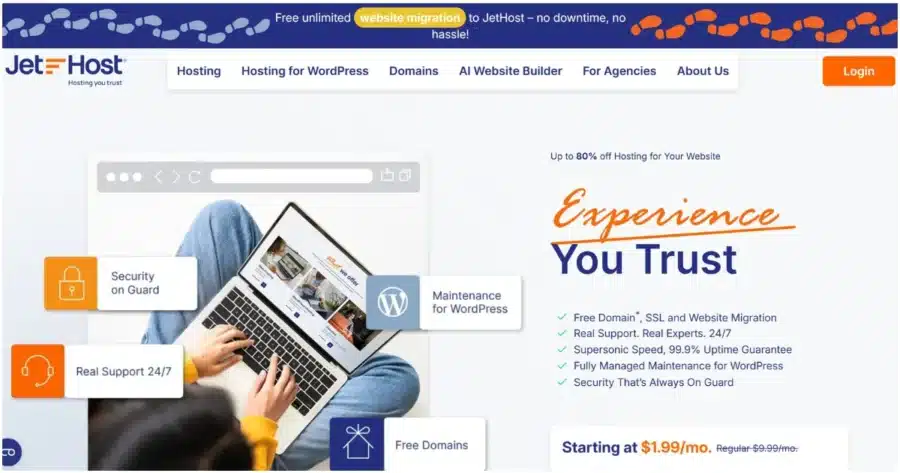
JetHost is built for small business owners, WordPress publishers, WooCommerce stores, and agencies who want managed hosting without the friction of legacy systems.
Rather than a broad general-purpose catalog, JetHost focuses on practical tools that reduce technical overhead, such as:
- WordPress Manager that centralizes updates
- staging
- security
- real human support available around the clock
- AI connection to the JetHost platform through a Model Context Protocol (MCP)
Key Features
- WordPress Manager with updates, staging, backups, SSL, and security from one dashboard
- cPanel hosting control panel with full site, email, and file management
- Patchstack integration for proactive WordPress vulnerability scanning and patch protection
- AI Website Builder that generates structure, content, and images from a business prompt
- JetHost AI Connector that retrieves real-time information through simple chat questions. Explore how AI Connector works.
- Free and unlimited website and email migration with no downtime
- LiteSpeed Enterprise, Redis, NVMe storage, Cloudflare CDN, HTTP/2, and HTTP/3 on relevant plans
- JetHost Total Care plugin for WordPress performance, security, and core controls
- 99.9% uptime guarantee
Pricing
Below is a breakdown of the available JetHost pricing plans:
| Plan | Intro Price | Renews From | Key Specs |
|---|---|---|---|
| Mini | $1.99/month | $8.99/month | 1 website, 15,000 visits/month, 10GB NVMe, up to 5 email accounts |
| Start | $2.99/month | $10.99/month | 25 websites, 30,000 visits/month, 25GB NVMe, free domain |
| Maverick | $5.99/month | $21.99/month | 100 websites, 90,000 visits/month, 75GB NVMe, SSH access |
| Business | $10.99/month | $36.99/month | 150 websites, 200,000 visits/month, 200GB NVMe, priority support |
Performance and Usability
JetHost runs LiteSpeed Enterprise, Redis caching, NVMe storage, and Cloudflare CDN alongside HTTP/2 and HTTP/3.
The client dashboard brings WordPress management, security, backups, and migration tools into one place, so site owners spend less time in settings and more time on their business.
Pros
- Free unlimited migration makes JetHost one of the most accessible GoDaddy replacements for users moving multiple sites and email accounts
- Patchstack and JetHost Total Care add a meaningful security and performance layer beyond what standard shared hosting typically includes
- 24/7 expert support is positioned as a technical partnership, not a generic ticket queue
Cons
- SSH access and Patchstack coverage are plan-specific and should be confirmed before purchasing
Switch to a host that puts people first.
JetHost offers unbeatable rates on domain registration, transfers, and renewals.
2. SiteGround

SiteGround suits WordPress and WooCommerce users who prioritize managed tooling, daily backups, and strong security across multiple global data centers. Performance and managed features matter more here than the lowest renewal price.
Key Features
- Eleven global data centers, server health monitoring every 0.5 seconds
- Daily backups, free SSL, free CDN, and free business email on all plans
- Security system designed to block the vast majority of malicious traffic
- 100% renewable energy match and 24/7 expert support
Pricing
| Plan | Intro Price | Renews From | Key Specs |
|---|---|---|---|
| StartUp | $2.99/month | $17.99/month | 1 website, 10GB storage, unlimited traffic |
| GrowBig | $4.99/month | $29.99/month | Unlimited sites, 50GB storage, staging |
| GoGeek | $7.99/month | $44.99/month | Unlimited sites, 100GB storage, advanced tools, priority resources |
Performance and Usability
SiteGround uses its proprietary Site Tools panel rather than cPanel, which suits managed WordPress workflows well but requires adjustment for cPanel-dependent teams. Managed caching, CDN, and unmetered transfer keep performance consistent across plan tiers.
Pros
- Daily backups and a proactive security layer protect sites with minimal manual configuration
- Support quality is consistently rated highly among WordPress and WooCommerce users
Cons
- Renewal pricing increases significantly above the introductory rate
3. Bluehost

Bluehost is a GoDaddy hosting replacement that targets first-time site owners and small businesses who want a simplified setup path, a free domain for the first year, and a dashboard built around ease of use rather than advanced configuration.
Key Features
- NVMe SSD storage and free CDN across all plans
- AI site creation tools and managed WordPress updates
- Free domain for the first year and free SSL
- 99.99% uptime SLA and global data centers
Pricing
The following Bluehost prices are listed for a 36-month term:
| Plan | Intro Price | Renews From | Key Specs |
|---|---|---|---|
| Starter | $3.99/month | $9.99/month | 10 websites, 10GB storage, 40,000 visitors/month |
| Business | $6.99/month | $13.99/month | 50 sites, 50GB storage, 200,000 visitors/month, domain privacy |
| eCommerce Essentials | $14.99/month | $21.99/month | 100 sites, 100GB storage, 400,000 visitors/month, WooCommerce tools, expanded storage |
Performance and Usability
Bluehost pairs NVMe storage and a global CDN with a dashboard designed for non-technical users. WordPress onboarding is guided and fast, making it one of the more approachable options among the best GoDaddy alternatives for people setting up their first site.
Pros
- Guided onboarding is especially helpful for site owners with no prior hosting background
- Free domain and SSL reduce the upfront cost of launching a new business site
Cons
- Advanced server control is limited on shared plans
- Renewal pricing can catch budget-focused buyers off guard at renewal time
For those who want to see how Bluehost stacks up against similar beginner-friendly hosts, our best Bluehost alternatives comparison has a full side-by-side breakdown.
4. Hostinger

Hostinger is one of the most popular alternatives to GoDaddy among budget-conscious beginners and small businesses. Its combination of low entry pricing, an intuitive control panel, and managed WordPress support makes it a competitive starting point.
Key Features
- Low entry pricing with managed WordPress and WooCommerce hosting options
- hPanel interface designed for quick navigation and beginner usability
- Free SSL, free domain on eligible annual plans, and automatic website migration
- AI site-building tools
Pricing
The pricing plans below outline the lowest price options for the 48-month subscription plan:
| Plan | Intro Price | Renews From | Key Specs |
|---|---|---|---|
| Premium | $2.99/month | $10.99/month | 3 websites, 20GB SSD storage, free domain for 1 year |
| Business | $3.99/month | $16.99/month | 50 websites, 50GB NVMe, daily backups |
| Cloud Startup | $7.99/month | $25.99/month | 100 websites, 100GB NVMe, 4 GB RAM |
Performance and Usability
Hostinger runs LiteSpeed on its shared hosting infrastructure, which contributes to solid page load times at the price point. hPanel is one of the more beginner-friendly interfaces available, keeping navigation fast for users who want a clean setup experience without a steep learning curve.
Pros
- Entry pricing is among the lowest for managed WordPress plans without removing core features
- hPanel simplifies navigation for users who find cPanel difficult or unfamiliar
Cons
- Lowest promotional pricing requires a 48-month initial subscription to unlock
- Shared plans have fixed resource allocations with no root access or server-level customization
If hPanel or the subscription commitment does not suit your workflow, our best Hostinger alternatives article covers comparable providers worth considering.
5. Namecheap
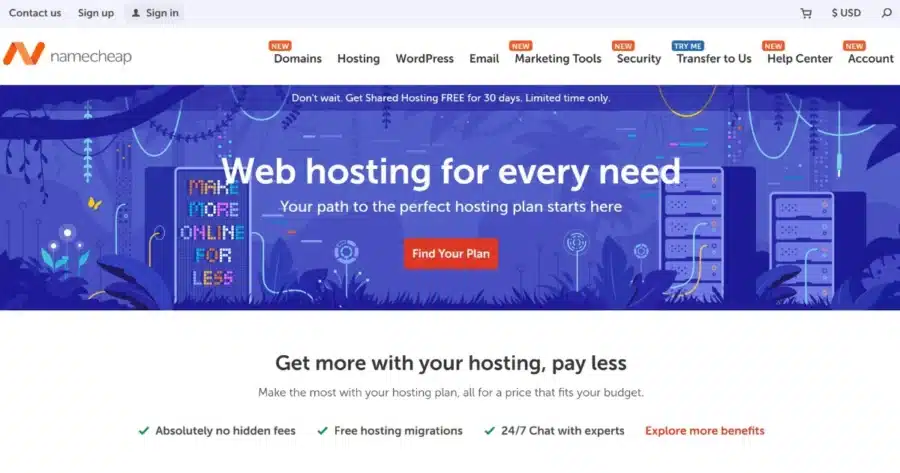
Namecheap is a better alternative to GoDaddy that fits domain buyers, freelancers, and price-sensitive site owners who want reliable cPanel shared hosting at a low entry price. Its strongest draw is the combination of competitive domain pricing, free WhoisGuard privacy on most TLDs, and a straightforward shared hosting setup built around cPanel.
Key Features
- cPanel with Softaculous one-click installs, free SSL, and free WhoisGuard domain privacy
- Automatic backups on Stellar Plus and Business plans
- Account isolation and efficient firewalls on all shared plans
- 24/7 live chat support and 100% monthly uptime guarantee on Stellar Plus and Business plans
Pricing
| Plan | Intro Price | Renews From | Key Specs |
|---|---|---|---|
| Stellar | $0 for 30 days | $5.88/month | 3 websites, 20GB storage |
| Stellar Plus | $0 for 30 days | $7.88/month | Unlimited websites, unmetered storage |
| Stellar Business | $0 for 30 days | $11.88/month | Performance boost, 50GB cloud storage, expanded features |
Performance and Usability
Namecheap is a strong fit for cPanel-familiar users and domain buyers. The Stellar Plus and Business plans include automatic backups and the 100% uptime guarantee, while the entry-level Stellar plan covers straightforward shared hosting needs. Shared plans give broad control over files, email, and applications through the standard cPanel interface.
Pros
- Domain and hosting bundle is genuinely low-cost at entry, making Namecheap a practical GoDaddy substitute for price-sensitive buyers
- Free WhoisGuard privacy protection is included at no extra cost, whereas many hosts charge separately for this
Cons
- Automatic backups and the 100% uptime guarantee are limited to Stellar Plus and Business; the entry Stellar plan does not include them
- High-traffic or resource-intensive sites will outgrow what shared hosting can provide and require a plan upgrade or a different provider
6. DreamHost

DreamHost appeals to developers and WordPress users who want a strong uptime commitment, modern infrastructure, and a clear step-up path across its shared hosting plan tiers. Its 100% uptime guarantee is a standout claim among shared hosting providers.
Key Features
- 100% uptime guarantee on eligible plans
- NVMe storage, Nginx, HTTP/2, and IPv6 support
- Daily automated backups on all web hosting plans
- Multi-factor authentication, auto-enabled sFTP, free domain for 1 year, free SSL
Pricing
| Plan | Intro Price | Renews From | Key Specs |
|---|---|---|---|
| Launch | $2.89/month | $10.99/month | 25 websites, 40,000 visits/month, 25GB NVMe |
| Growth | $3.99/month | $12.99/month | 50 websites, 200,000 visits/month, 50GB NVMe |
| Scale | $9.99/month | $25.99/month | 100 websites, 400,000 visits/month, 100GB NVMe |
Performance and Usability
DreamHost uses a custom control panel rather than cPanel. NVMe storage and Nginx contribute to solid page delivery, but teams expecting cPanel will need an adjustment period.
Pros
- The 100% uptime guarantee is among the strongest public commitments in shared hosting
- Daily automated backups are included on all plans with no additional configuration required
Cons
- Custom panel is unfamiliar for users expecting cPanel
- Visit and storage limits are plan-specific, requiring an upgrade for larger projects
7. HostGator

HostGator is one of the most established shared hosting providers in the US market, built for small businesses, bloggers, and site owners who want a cPanel-based setup with clearly tiered plans and a free domain for the first year. It competes directly with GoDaddy’s general-purpose shared hosting audience and offers a more straightforward plan structure with unmetered bandwidth from the entry tier.
Key Features
- cPanel with Softaculous one-click installs across all shared plans
- Free domain for the first year and free SSL on all plans
- Unmetered bandwidth and free CDN on all shared plans
- AI site creation tools and one-click WordPress installation
- DDoS protection, 24/7 live chat, and phone support
Pricing
| Plan | Intro Price | Renews From | Key Specs |
| Hatchling | $3.75/month | $10.99/month | 10 websites, 10GB SSD, 40,000 visits/month |
| Baby | $4.50/month | $16.49/month | 20 websites, 50GB SSD, 50,000 visits/month |
| Business | $6.25/month | $21.99/month | 50 websites, 50GB SSD, 200,000 visits/month |
| Pro | $13.95/month | $26.69/month | 100 websites, 100GB SSD, 400,000 visits/month |
Performance and Usability
HostGator uses cPanel across all shared plans, making it an immediate lateral move for anyone already on GoDaddy’s cPanel setup. Plans are tiered by website count, storage, and monthly visit guidance, keeping the choice between tiers straightforward. The AI site creation tools and one-click WordPress installer reduce time to a live site for first-time owners.
Pros
- cPanel familiarity means no learning curve for users switching from GoDaddy or other cPanel hosts
- Malware scanning, WAF, and DDoS protection are included on all plans without paying for a security add-on
Cons
- Renewal pricing increases substantially; the Hatchling plan can more than double at renewal
- Professional website migration is a paid add-on; the included migration tool is self-serve only
If the renewal jump or the paid migration setup is a concern, our best HostGator alternatives guide covers shared hosting providers with more predictable long-term pricing.
8. Hosting.com

As a GoDaddy substitute, Hosting.com targets performance-focused shared hosting buyers who want the benefits of LiteSpeed infrastructure and cPanel familiarity without moving to a cloud platform.
Key Features
- LiteSpeed Webserver and NVMe SSD storage on all plans, not only higher tiers
- AMD EPYC CPUs with HTTP/2 and HTTP/3 support
- Daily automated backups stored off-server, with a 30-day restore window
- Free migration with cPanel migration support
- SSL, Monarx malware protection, DDoS protection, and brute-force blocking
Pricing
| Plan | Intro Price | Renews From | Key Specs |
|---|---|---|---|
| Starter | $2.99/month | $11.99/month | 1 website, 15GB NVMe storage |
| Plus | $3.99/month | $14.99/month | 2 websites, 30GB NVMe storage |
| Pro | $6.99/month | $22.99/month | 10 websites, 50GB NVMe storage |
| Max | $8.99/month | $27.99/month | 100 websites, 100GB NVMe storage |
Performance and Usability
LiteSpeed, AMD EPYC CPUs, and NVMe storage apply across all plans on hosting.com, not only higher tiers. The cPanel control panel suits users familiar with traditional shared hosting management.
Pros
- LiteSpeed and NVMe storage are included on every plan, not gated behind premium tiers
- 24/7 in-house phone support is a differentiator among mid-range shared hosting providers
Cons
- Renewal pricing increases noticeably above the introductory rate
- Daily backup retention is 30 days, which may not suit compliance-sensitive projects
Teams wanting to compare hosting.com against similar mid-range providers can find a full breakdown in our Hosting.com alternatives guide.
Which GoDaddy Alternative to Pick
The right GoDaddy substitute depends on your use case, technical comfort level, and budget timeline. Here is a straightforward breakdown:
- If you want managed hosting with expert support and free unlimited migration, JetHost is the leading GoDaddy alternative for small businesses and WordPress publishers.
- If daily backups and managed security are your top priority, SiteGround offers a managed toolset that is better than GoDaddy’s shared hosting for performance-conscious site owners.
- If you are setting up your first site and need guidance throughout, Bluehost offers the most beginner-friendly experience.
- If entry price is the primary concern, Hostinger or Namecheap offer the lowest starting costs.
- If you need a strong uptime guarantee and developer-friendly infrastructure, DreamHost is a solid fit.
- If you want an established cPanel host with unmetered bandwidth and a straightforward plan structure, HostGator is a proven shared hosting choice for small businesses and bloggers.
- If you want LiteSpeed performance on shared hosting with cPanel included, Hosting.com is a reliable mid-range pick.
Full Hosting Provider Comparison
Below is a full comparison of the best GoDaddy alternatives covered in this guide:
| Provider | Pricing | Performance | Ease of Use | Scalability | Support | Best For |
|---|---|---|---|---|---|---|
| JetHost | From $1.99/mo | LiteSpeed, Redis, NVMe | Intuitive WP Manager | 4 plans | 24/7 human experts | SMBs, WP, WooCommerce |
| SiteGround | From $2.99/month | Managed stack, CDN | Site Tools panel | 3 plans | 24/7 expert | Managed WordPress |
| Bluehost | From $3.99/month | NVMe, CDN | Beginner-first | 3 plans | 24/7 | First-time site owners |
| Hostinger | From $2.99/month | LiteSpeed, NVMe | hPanel, simple | 3 plans | 24/7 | Budget beginners |
| Namecheap | From $0 for a 30-day period | Standard shared | cPanel | 3 plans | 24/7 live chat | Domains, budget hosting |
| DreamHost | From $2.89/month | NVMe, Nginx | Custom panel | 3 plans | 24/7 | Developers, WP users |
| HostGator | From $3.75/month | SSD, cPanel | cPanel, familiar | 4 plans | 24/7 live chat + phone | Small businesses, bloggers |
| Hosting.com | From $2.99/month | LiteSpeed, NVMe | Standard cPanel | 4 plans | 24/7 phone | Speed-focused shared |
Conclusion
The best GoDaddy alternatives in 2026 address its three most cited gaps: pricing transparency, support quality, and infrastructure depth.
These GoDaddy replacements each cover a specific priority:
- JetHost: expert support and free migration
- SiteGround: backups and managed security
- Bluehost: guided beginner setup
- Hostinger: low entry pricing
- Namecheap: budget domain and hosting
- DreamHost: uptime guarantee and flexibility
- HostGator: established cPanel hosting with unmetered bandwidth
- Hosting.com: LiteSpeed on shared hosting
Each of these GoDaddy competitors solves a different problem. Match the host to your use case, not its name.
Start with the best overall pick
Frequently Asked Questions
What is the best overall GoDaddy alternative in 2026?
JetHost is the best overall GoDaddy alternative for small businesses, WordPress publishers, and WooCommerce stores. It combines managed WordPress tools, free and unlimited migration, Patchstack vulnerability protection, and 24/7 human expert support. Where GoDaddy casts a wide net, JetHost is specifically built to reduce technical friction for everyday site owners.
Why do users look for GoDaddy substitutes?
The most commonly cited reasons are steep renewal prices that significantly exceed introductory rates, support experiences that feel generic rather than expert-led, and difficulty comparing actual costs when add-ons are layered in. Many site owners eventually seek GoDaddy substitutes that offer more transparent pricing and faster, personalized support.
Do all GoDaddy alternatives support cPanel?
No. Several of the top website hosting alternatives to GoDaddy include cPanel. JetHost, Namecheap, HostGator, and Hosting.com all offer cPanel on their shared hosting plans. SiteGround uses its own Site Tools panel, DreamHost uses a custom dashboard, and Hostinger uses hPanel. Confirm which control panel is included before signing up.
Can I migrate my site from GoDaddy for free?
Yes, JetHost offers free and unlimited website and email migration, which is especially useful for users moving multiple sites at once. When evaluating the best web hosting providers instead of GoDaddy, always confirm whether the migration scope covers email accounts and databases, not only website files, as this varies significantly by provider.


Top articles
Our Picks
- 6 minutes read
7 Signs It’s Time to Switch Your Web Hosting Provider
Most people don’t think about their hosting until something breaks. But if your website has been acting up – slower pages, random errors, or unreliable support – it might be…
- 4 minutes read
eDesign Interactive on Pressure, People & Creativity
Client: George, CEO of eDesign Interactive Industry: Web Design, Digital Strategy & Interactive Marketing Website: edesigninteractive.com Relationship: Long-time collaboration with the team behind JetHost
- 2 minutes read
Case Study: How SEO Rush Got 5x Faster with JetHost
Client: SEORUSH Industry: SEO & Digital Marketing Website: seorush.org Service: JetHost WordPress Hosting When you run an SEO agency, your website needs to perform as well as the results you…
Related Posts
 13 minutes read
Hosting for WordPress for Web Designers: 6 Providers That Keep Client Sites Fast
The best hosting for WordPress for web designers is JetHost, Hostinger, and SiteGround, followed by Bluehost, DreamHost, and HostGator. Your web designer portfolio does more than showcase your work. It…

-
8 minutes read
Weebly Shutting Down: 6 Alternatives to Migrate Your Site To
Weebly is shutting down in 67 countries. If you’re affected, you need to move your site to a new platform by December 26, 2026. Consider these alternatives: JetHost, Wix, Squarespace,…
- 3 minutes read
10 best File Transfer Protocol (FTP) clients
Everyone who runs a website ends up needing one: a good FTP client. It is the app that moves files between your computer and your server – and the difference…