

The best hosting for WordPress for ecommerce is JetHost, followed by SiteGround, Cloudways, Hostinger, WPX Hosting, IONOS, ScalaHosting, and Bluehost.
eCommerce hosting is a different decision than picking hosting for a blog, since a slow checkout or outages during sales mean lost revenue.
Across these eight providers, we checked plan limits, renewal pricing, and ecommerce-specific features directly against what each provider lists on its pages.
We looked at what users online say about each of these providers and compared their offerings to present you with a list of the best ecommerce hosting for WordPress (WP) sites.
Below, we group WP hosts by the type of store they fit best, along with their pricing and key online shop features.
Top WP Hosting Platforms for eCommerce at a Glance: Pricing and Fit
Here’s a quick breakdown of the best WordPress hosting providers for ecommerce with their starting prices and best fit:
| Position | Provider | Starting price | Best fit |
|---|---|---|---|
| 1 | JetHost | $2.99/month | Stores wanting managed performance with real support |
| 2 | SiteGround | $2.99/month | Stores prioritizing benchmarked page speed |
| 3 | Cloudways | From $14/month, varies by provider and server size | Agencies and growing stores wanting cloud flexibility |
| 4 | Hostinger | $3.99/month | First-time sellers on a tight budget |
| 5 | WPX Hosting | $29.16/month | Stores prioritizing fast support over low price |
| 6 | IONOS | $16/month | Stores wanting one AI-built plan with no tier decisions |
| 7 | ScalaHosting | $14.95/month | Stores wanting VPS isolation at shared prices |
| 8 | Bluehost | $14.99/month | Beginners wanting a bundled plugin stack |
*Prices reflect entry-level promotional rates on the provider’s primary WooCommerce-suited plan.
1. JetHost: The Best Hosting for WordPress for eCommerce with Managed Performance and Real Support
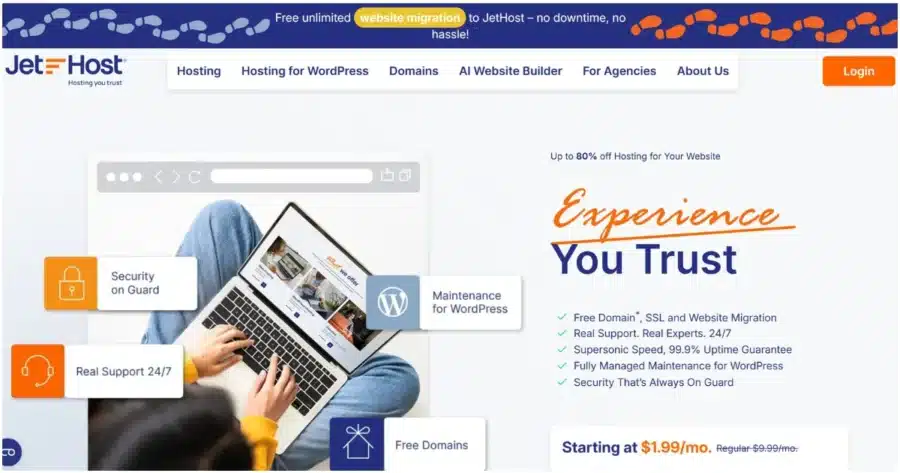
JetHost’s hosting for online shops is built around technical website performance and support that understands the WooCommerce platform.
Key Features of JetHost for eCommerce Stores
- Isolated CPU, RAM, and I/O per account, so another customer’s traffic spike never slows your store.
- LiteSpeed Enterprise with Redis object caching, which speeds up catalog browsing and checkout. Read the full breakdown of LiteSpeed web server benefits to see why it makes a difference.
- Free website and email migration, covering products, orders, and customer data.
- An AI-assisted WooCommerce store setup that can draft product descriptions and homepage copy from a prompt.
- JetHost Total Care plugin—a free tool covering WordPress core security, privacy, and performance settings.
- Patchstack vulnerability protection for the WordPress core, plugins, and themes.
- JetHost AI Connector provides instant access to live, account-specific hosting information through an AI agent of your choice (ChatGPT, Claude, Loveble, Cursor).
Pricing: WP Start runs $2.99/month (renewing at $10.99), WP Maverick runs $5.99/month (renewing at $21.99), and WP Business runs $10.99/month (renewing at $36.99). All three include unlimited products, a free first-year domain on annual or longer terms, free SSL, free Cloudflare CDN, and free WooCommerce migration.
Best for: Small to mid-sized WooCommerce stores that want managed-level performance and migration handled for them, without paying premium managed-WordPress rates.
Ready to see it in action? Explore JetHost’s hosting for WooCommerce and get a closer look at the plans, pricing, and tools.
2. SiteGround: For Stores Chasing Benchmarked Speed

SiteGround built its reputation on measurable WordPress and WooCommerce performance, with independent tests often showing fast checkout page loads. It’s a regular pick on lists of the best managed WordPress hosting for ecommerce.
Key Features of SiteGround for eCommerce
- WooCommerce auto-install on every plan, with multilevel caching tuned to keep shopping carts and checkouts dynamic.
- Free domain, SSL, CDN, and daily backups across every tier, including the entry-level StartUp plan.
- Free, expert-handled site migration on all plans, plus a self-service WordPress Migrator plugin.
Pricing: The StartUp plan costs $2.99/month and renews at $17.99/month, but it supports only one website. GrowBig costs $4.99/month and renews at $29.99/month with unlimited websites and on-demand backups, while GoGeek costs $7.99/month and renews at $44.99/month, adding Git, white-label access, and priority support.
Best for: Online stores that prioritize measured page-load performance and can absorb a steeper renewal cost in exchange for it.
We also have a dedicated JetHost vs. SiteGround breakdown that lines up renewal pricing and support side by side.
3. Cloudways: For Agencies and Stores That Want Cloud Flexibility
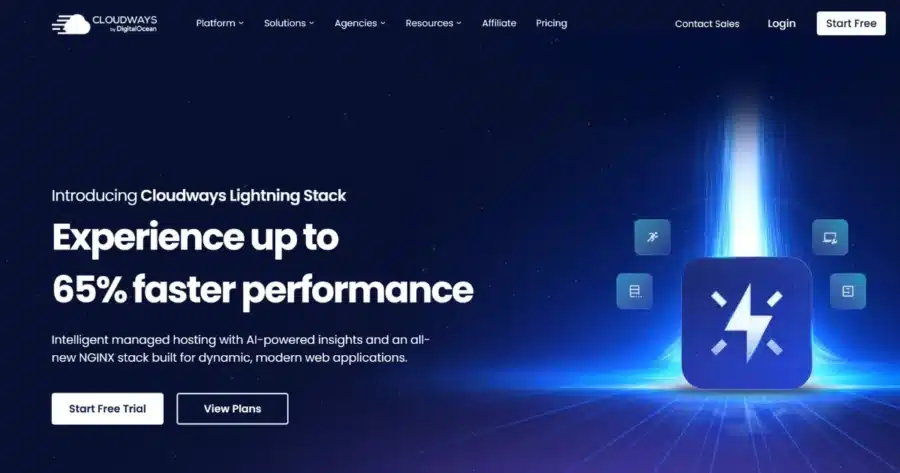
The next best hosting for WordPress for ecommerce is Cloudways. It takes a different approach entirely. Instead of its own servers, it manages hosting on top of providers like DigitalOcean, AWS, Vultr, Linode, and Google Cloud, letting you pick the infrastructure underneath.
Key Features of Cloudways for eCommerce
- Choice of five cloud infrastructure providers per server, with dedicated resources rather than shared capacity.
- Pre-configured Nginx, Varnish, and Redis caching stack built for fast product pages and checkouts.
- Pay-as-you-go billing with no long-term contract and no scheduled renewal price jump.
Pricing: Since Cloudways lets you choose your cloud provider and server size, its WooCommerce pricing isn’t tied to fixed plan tiers. As a general anchor, entry-level servers of DigitalOcean, Vultr, and Linode start at $14/month, with cost scaling up from there based on RAM, CPU, and storage rather than a preset plan name.
Best for: Agencies and growing stores that want cloud-level scalability without configuring raw servers themselves, and that can live with more setup decisions than a typical shared host requires.
4. Hostinger: For First-Time Sellers on a Budget

Hostinger is known for its low entry pricing. Its managed WooCommerce plans are suitable for online stores with light to moderate traffic.
Key Features of Hostinger for eCommerce Shops
- Business+AI and Cloud Startup+AI plans built specifically for WooCommerce, supporting up to 50 or 100 websites.
- AI website builder and AI-generated product descriptions included in store setup.
- Free domain, unlimited SSL, and free migration handled by Hostinger’s team within 24 hours.
Pricing: The Business + AI plan starts at $3.99/month on a 48-month term and renews at $16.99/month, with 50 GB of NVMe storage. The Cloud Startup + AI plan is $7.99/month and renews at $25.99/month, adding priority support, a dedicated IP, and 100 PHP workers for busier stores.
Best for: Budget-conscious sellers launching a first store who can commit to a longer billing term and plan to upgrade as traffic grows.
If you want to see how Hostinger holds up against other hosting providers, our best Hostinger alternatives roundup walks through the comparison.
5. WPX Hosting: For Stores That Want Fast Support Over the Lowest Price

WPX built its name on support speed, averaging close to 30 seconds to first response, paired with its own XDN content delivery network spanning more than 40 endpoints.
Key Features of WPX Hosting for eCommerce
- Average support response time is near 30 seconds, with a “Fixed For You” guarantee on every plan.
- Site and email migration included in every package, plus malware scans and removal at no extra cost.
- Redis cache and 8 GB or more of RAM on every WooCommerce-specific plan.
- XDN content delivery network included free, with no add-on fees for CDN or security tools.
Pricing: The Powerstore plan promotional price is $29.16/month and covers one high-performance store with 8 GB RAM and 20 GB storage. Superstore is $62.49/month for up to three sites with 36 GB RAM. Hyperstore costs $124.99/month for up to five stores with 80 GB RAM.
Best for: WooCommerce online stores and agencies that value support speed and dedicated resources more than the lowest possible entry cost.
6. IONOS: For Stores Wanting One AI-Built Plan With No Tier Decisions

IONOS takes a simpler approach than most of this list. Instead of multiple WooCommerce tiers, it offers one plan built around an AI setup and a fixed, predictable feature set.
Key Features of IONOS for eCommerce
- AI plugins that can build a complete store, including content and images, from prompts.
- 100 GB SSD storage, free Jetpack backup, and unlimited products and categories.
- 768 MB of PHP memory and the latest PHP versions for stable store performance.
- SSH, SFTP, WP-CLI, and Git support for developers who want to customize beyond the AI build.
Pricing: The plan starts at $16/month on a 1-year term and renews at $22/month afterward.
Best for: Stores that want a single, predictably priced plan with AI handling the initial build, rather than comparing several WooCommerce tiers.
7. ScalaHosting: For VPS-Level Isolation at Shared Prices
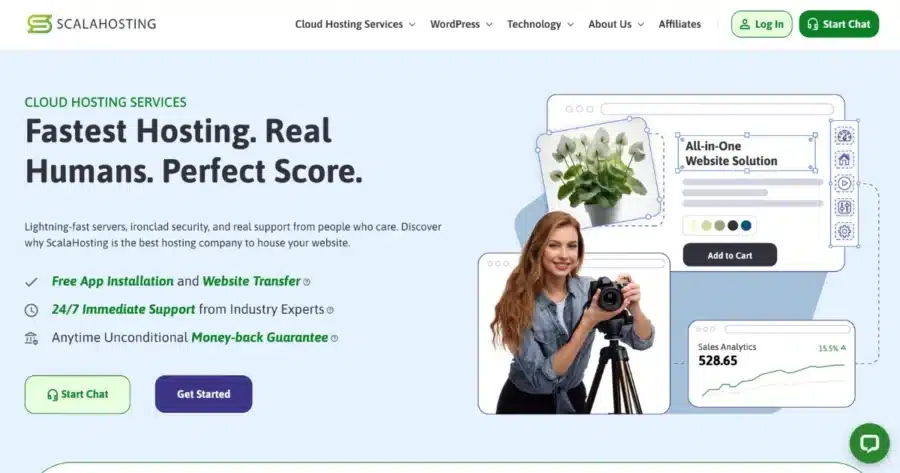
ScalaHosting’s Managed WooCommerce plans run on cloud VPS infrastructure rather than shared servers, with its own SPanel control panel standing in for cPanel.
ScalaHosting’s team handles server setup, security hardening, performance tuning, and plugin or theme installs, so you’re not left configuring a raw VPS on your own.
Key Features of ScalaHosting for eCommerce
- SShield AI security system aimed at blocking server-level attacks before they reach the site.
- WordPress Manager tool for installs, updates, and backups from a single dashboard.
- Free, no-downtime WooCommerce migration handled by ScalaHosting’s team.
- Dedicated CPU, RAM, and storage that you can adjust to match your needs.
Pricing: Entry Cloud plan starts at $14.95/month on promotional terms, with renewal pricing increasing nearly twice ($39.95/mo) afterward, in line with other discount-led hosts.
Best for: Stores that want genuine VPS-level resource isolation without managing a server directly, and that don’t mind a learning curve moving away from cPanel.
8. Bluehost: For Beginners Wanting a Bundled Plugin Stack
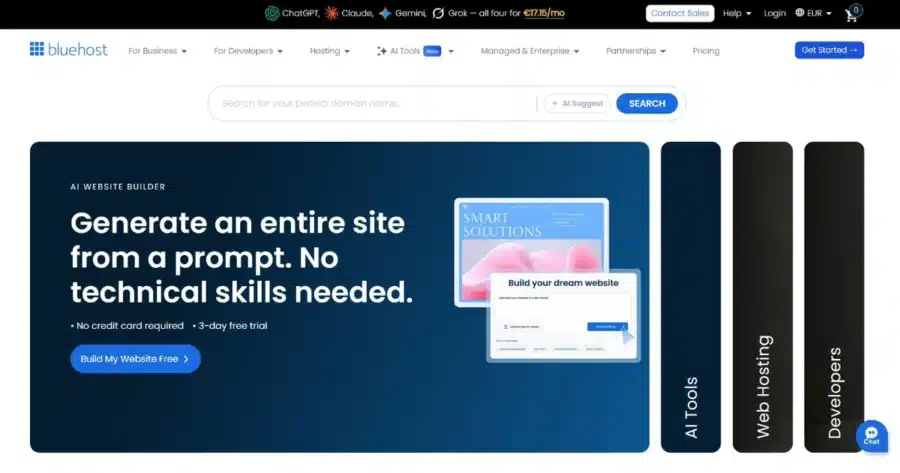
Bluehost remains one of the most recognized names in hosting, and its two WooCommerce-specific bundles are aimed squarely at first-time online sellers. It shows up in searches for the best WordPress hosting for ecommerce because of the strong presence on the market, though the bundled WP plugins are the real differentiator.
Key Features of Bluehost for eCommerce
- eCommerce Essentials and eCommerce Premium plans with 16 premium. WooCommerce plugins pre-installed, including Yoast SEO and YITH extensions.
- AI-powered store builder that can generate a layout from a prompt.
- Free domain and SSL for the first year, plus a free store migration tool.
- 99.99% uptime SLA on shared hosting plans.
Pricing: The eCommerce Essentials plan starts at $14.99/month for a 36-month commitment and renews at $21.99/month. It includes a free domain, SSL, and WooCommerce pre-installed.
Best for: First-time store owners who want a host with a wide plugin bundle handled for them.
If that upgrade timeline has you thinking ahead already, our best Bluehost alternatives guide is worth a look before you commit.
What to Look For in a WordPress Hosting for eCommerce
Here are the five most important factors when choosing a hosting for ecommerce on WordPress:
- Resource isolation: Shared hosting without isolated CPU and RAM can slow down during another customer’s spike, which is exactly the wrong moment for your own sale to underperform.
- Renewal pricing: The number that matters is what you pay after the first term, not the promotional rate, since most providers raise prices significantly at renewal.
- Migration support: An online shop carries more moving parts than a blog, including orders, customer records, and product images, so free expert-handled migration lowers the risk of switching.
- Caching and database performance: Redis or object caching has a measurable, not theoretical, effect on WooCommerce page speed, especially once a catalog grows past a few dozen products.
- Support depth: WooCommerce-specific problems, like a plugin conflict breaking checkout, are resolved faster by support staff who know the platform rather than general hosting support.
Conclusion
The best hosting for WordPress for ecommerce has to cover all the basic necessities an online store has. This includes fast performance, strong security, reliable uptime, automatic backups, and helpful customer support.
JetHost is the strongest overall pick for ecommerce stores, as it covers all of these needs.
SiteGround and Cloudways come closest on performance and flexibility. Hostinger and Bluehost cover the basics affordably for a first store. ScalaHosting, WPX, and IONOS fit stores with more specific needs.
Whichever you pick, make sure it covers your specific requirements, not just what the pricing page highlights.
If you want a store that stays fast during a sales rush and a real person to call when something breaks, start your move to JetHost today.
FAQ
Does WooCommerce need its own hosting, or will a standard WordPress plan work?
A standard plan can work for a very small shop, but most providers, JetHost included, offer WooCommerce-specific tiers with more CPU, RAM, and caching built in. A WooCommerce store puts more load on a server than a typical WordPress site because of product catalogs, checkout sessions, and plugin-driven database queries.
What’s a realistic monthly budget for eCommerce hosting?
Entry pricing across the providers above ranges from roughly $3 to $15 a month on promotional terms, while some managed hosts start closer to $30. Renewal pricing is almost always higher than the intro rate, sometimes substantially, so check that figure before committing to a multi-year term.
Will my online store survive a sudden traffic spike, like a flash sale?
Yes, it will, as long as your hosting account has isolated resources instead of sharing CPU and RAM with other customers on the same server. For example, JetHost isolates resources per account so another customer’s spike doesn’t slow your store down, while basic shared plans carry more exposure to that risk.
How risky is moving an existing WooCommerce store to a new host?
It’s riskier than moving a simple website, since orders, customer data, and product images all need to be transferred without loss. That’s why hosts like JetHost offer free expert-handled migration to minimize that risk.
At what point does a store need VPS or dedicated hosting instead of shared or cloud plans?
Shared or cloud hosting with WooCommerce-optimized resources comfortably covers most small and mid-sized stores. VPS or dedicated hosting becomes worthwhile once a store starts regularly pulling tens of thousands of monthly visits or running a large catalog, which is where providers like ScalaHosting become more relevant.


Top articles
Our Picks
- 6 minutes read
7 Signs It’s Time to Switch Your Web Hosting Provider
Most people don’t think about their hosting until something breaks. But if your website has been acting up – slower pages, random errors, or unreliable support – it might be…
- 4 minutes read
eDesign Interactive on Pressure, People & Creativity
Client: George, CEO of eDesign Interactive Industry: Web Design, Digital Strategy & Interactive Marketing Website: edesigninteractive.com Relationship: Long-time collaboration with the team behind JetHost
- 2 minutes read
Case Study: How SEO Rush Got 5x Faster with JetHost
Client: SEORUSH Industry: SEO & Digital Marketing Website: seorush.org Service: JetHost WordPress Hosting When you run an SEO agency, your website needs to perform as well as the results you…
Related Posts
 3 minutes read
10 best File Transfer Protocol (FTP) clients
Everyone who runs a website ends up needing one: a good FTP client. It is the app that moves files between your computer and your server – and the difference…

- 13 minutes read
Top 8 Hosting Providers for WordPress for Educational Institutions: From Schools to Universities
The best hosting for WordPress for education websites includes JetHost, Hosting.com, SiteGround, Bluehost, and DreamHost, followed by Hostinger, HostGator, and WPX. Educational websites range from simple school information pages to…
- 12 minutes read
6 Best Hosting Providers for Freelancers Using WordPress in 2026
The best hosting for WordPress for freelancers is JetHost, Hostinger, Bluehost, HostGator, Hosting.com, and SiteGround, each suited to a different type of freelance work. A freelancer’s website is more than…