

The best hosting for WordPress for enterprise companies are JetHost, Hosting.com, WPX, and BigScoots, followed by SiteGround and DreamHost.
We see the same problems come up in almost every enterprise hosting conversation. Traffic spikes overwhelm shared infrastructure, security gaps put data at risk, and support cannot keep pace with growth.
We based this comparison of WordPress (WP) hosts on verified pricing pages and specs for every provider. JetHost leads the list for teams that want enterprise-level capacity paired with a human support team instead of a ticket queue.
Quick Comparison of Hosting for WordPress for Enterprise
Here’s how the top picks stack up on pricing, capacity, and the features that matter most for enterprise-scale WordPress operations:
| Provider | Plan Featured | Best Features | Intro Price | Renewal Price | Enterprise Strength |
|---|---|---|---|---|---|
| 1. JetHost | WP Business | Human support with generous site limits | $10.99/month | $36.99/month | 150 websites, 200GB Cloud NVMe storage |
| 2. Hosting.com | Turbo WordPress | Premium edge infrastructure and enterprise security | $24.99/month | $69.42/month | Enterprise CDN, WAF, Object Cache Pro |
| 3. WPX | Professional | Fast global CDN and rapid live chat support | $49.99/month | $59.99/month | 43-location XDN CDN, DDoS protection |
| 4. BigScoots | Core 500 | Fully owned infrastructure, personal support | $166.67/month | Not disclosed | Control over performance, fast support replies |
| 5. SiteGround | GoGeek | White-label access, Git tools | $7.99/month | $44.99/month | Unlimited websites, priority support |
| 6. DreamHost | Scale | Unlimited SFTP/Shell Users | $9.99/month | $25.99/month | 100 websites, unmetered bandwidth |
The 6 Best WordPress Hosts for Enterprise Teams
We evaluated each provider below on infrastructure quality, security depth, support responsiveness, and pricing transparency at enterprise scale.
1. JetHost
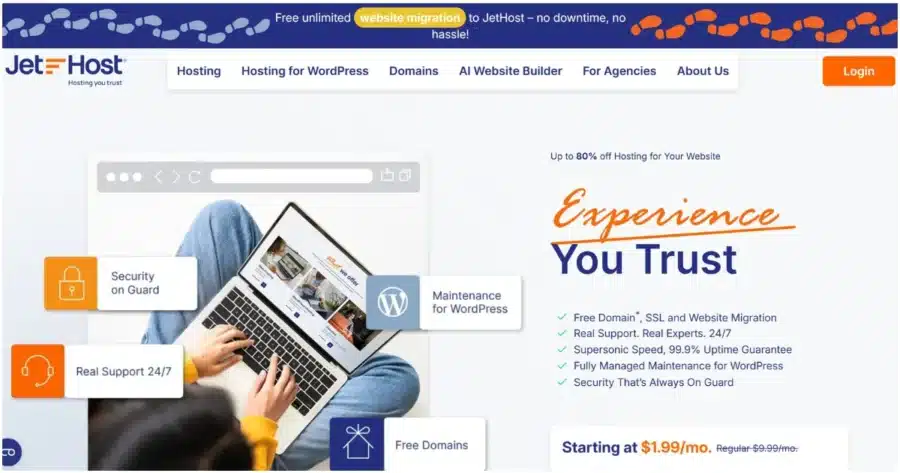
JetHost built its infrastructure around WordPress specifically. The WP Business plan is the company’s top tier, purpose-built for portfolios that have outgrown smaller shared plans.
Why it stands out
JetHost’s WP Business plan makes hosting for WordPress for enterprise teams practical without a steep learning curve. It includes 150 websites, 200GB of NVMe storage, and room for 200,000 monthly visits, all with unlimited web traffic. JetHost backs this capacity with 24/7 human support, treated as central to the product rather than an add-on.
Enterprise features
WordPress Manager gives site administrators one dashboard for updates, staging, backups, SSL, and login security across every site on the account. Hosting WP on enterprise-grade infrastructure is the goal of this dashboard, which also connects to Patchstack for WordPress vulnerability scanning. Patchstack comes free for one domain on the Business plan.
LiteSpeed Cache and Smart Cache Control with Redis handle performance, while WP-CLI, Git, and SSH access give developers direct server-level control.
The free JetHost Total Care plugin adds extra security, privacy, and performance controls beyond what most WordPress sites configure by default. Teams that need a new property fast can also use the AI Website Builder to generate a starting structure in minutes.
Free, unlimited migration also means a large portfolio moves over without days of manual file transfers.
The JetHost AI Connector lets teams work with the hosting directly from Claude, ChatGPT, Cursor, or Lovable through MCP integration.
Best fit for
Businesses running dozens of WordPress sites that want enterprise capacity without losing a real support relationship fit best here.
What to keep in mind
The $10.99 intro rate renews at $36.99/month. JetHost states 99.9% uptime rather than a higher figure. The free domain offer applies only on annual or longer terms for select extensions.
Ready for enterprise-level hosting capacity with real human support?
For projects that need more than what shared or managed hosting offers, JetHost also offers VPS plans with dedicated resources.
2. Hosting.com

Hosting.com’s WordPress product runs on a premium, edge-optimized infrastructure built for speed. The Turbo plan is the top tier, built for portfolios that need serious traffic headroom.
Why it stands out
Enterprise hosting for WordPress took a real step forward for Hosting.com, thanks to a premium infrastructure upgrade underneath.
Every site gets a pre-configured Enterprise CDN and web application firewall with no manual setup required. Object Cache Pro is included from the Medium plan upward, while Turbo adds Relay, a PHP caching layer designed to improve application performance.
Enterprise features
The Turbo plan supports up to 50 WordPress installs, 500,000 monthly visits, and 200GB of NVMe storage.
You also get free migrations of an unlimited number of sites without downtime, handled by the Hosting.com team. Malware scanning and patching run continuously, and backups keep a 14-day retention window across all tiers.
Best fit for
Performance-focused teams running high-traffic or WooCommerce sites that want enterprise CDN and firewall protection built in, not bolted on, fit well here.
What to keep in mind
The Turbo plan’s intro price of $24.99/month renews at $69.42/month, a bigger jump than some competitors on this list.
Teams weighing more options can see the full lineup in our Hosting.com alternatives guide.
3. WPX

WPX built its entire platform around WordPress and WooCommerce, and that focus shows in what it does not have to compromise on. The Professional plan sits at the top of its lineup, aimed at agencies and larger sites.
Why it stands out
Hosting for WordPress enterprise websites is where WPX built its reputation, backed by XDN, a custom-built CDN spanning dozens of global locations.
Enterprise-level DDoS protection comes free with every plan. This feature costs extra with many other hosts. WPX’s live chat support targets a 30-second average response time, which matters when a site issue needs a fast fix.
Enterprise features
Every WordPress install includes staging, automatic daily backups, and free, unlimited migrations handled by the WPX team.
The custom control panel gives direct access to file management, databases, and email in one place. Active malware scanning and removal run continuously across every plan at no added cost.
Best fit for
Businesses running multiple brand sites that want fast global delivery and quick support are well-suited here.
Running an online store? Explore our comparison of the best WP hosting for ecommerce.
What to keep in mind
The Professional plan covers up to 15 websites and 40GB of SSD storage, tighter limits than some competitors at a similar price.
4. BigScoots

BigScoots owns and operates 100% of the server hardware behind its hosting, meaning no resold capacity and no noisy neighbors crowding shared infrastructure.
The Core 500 plan is built for growing sites that need dedicated resources and hands-on support.
Why it stands out
Hosting for enterprise WordPress websites is BigScoots’ specialty, and the company backs it with Tier III+ data centers.
Support replies in under 90 seconds on average. Clients get access to caching, security, and performance plugins that the BigScoots team configures and manages.
Enterprise features
Every new account includes a free, zero-downtime migration handled by the BigScoots team. Cloudflare integration optimizes network paths on top of the dedicated hardware.
The data center holds SOC and PCI-DSS compliance certifications, useful for regulated industries.
Best fit for
Mission-critical sites and WooCommerce stores that need dedicated, fully owned infrastructure and fast support are a good fit for this plan.
What to keep in mind
Core 500 covers 5 websites and 500,000 monthly visits at a $166.67/month intro price. Larger portfolios need the pricier Core 1000 plan or a custom Enterprise tier.
5. SiteGround

SiteGround’s GoGeek plan sits at the top of its WordPress lineup. It adds extra resources and features that make it a clear step up from GrowBig.
Why it stands out
GoGeek offers hosting for WordPress for large businesses that need more room than GrowBig provides. It allocates more server resources, so bigger, busier sites don’t slow down.
Priority support gets faster replies on live chat and tickets. Git integration comes built in, so development teams get version control at no extra cost.
Enterprise features
GoGeek includes unlimited websites, 100GB of storage, and unmetered bandwidth for sites that outgrow SiteGround’s lower tiers.
A private DNS lets agencies present a fully branded experience to clients. Staging and on-demand backups carry over from lower tiers, alongside faster PHP processing.
Best fit for
Large organizations running multiple internal brands or business units benefit from GoGeek’s white-label control panel and Git-based deployment workflow.
What to keep in mind
The $7.99/month introductory rate renews at the regular $44.99/month price, resulting in significantly higher long-term costs.
6. DreamHost

DreamHost’s Scale plan is the top option in its hosting range. It offers enterprise-level capacity without the typical enterprise-level price tag.
Why it stands out
Hosting for WordPress for enterprise organizations doesn’t have to come with a steep price tag.
DreamHost’s Scale plan proves it with 100 websites and unmetered bandwidth. Every plan includes free site migrations, daily backups, and NVMe SSD storage handled by DreamHost’s in-house WordPress support team. A free domain comes with any annual plan, alongside free SSL on every site.
Enterprise features
Scale supports up to 400,000 monthly visits and 100GB of NVMe SSD storage, which is a generous headroom for the price. 24/7 support comes from DreamHost’s own WordPress specialists, not a general help desk. Unmetered bandwidth means traffic spikes do not trigger overage charges.
Best fit for
This plan suits budget-conscious businesses that need real capacity and solid support without the premium managed hosting price.
What to keep in mind
Scale’s $9.99/month intro price renews at $25.99/month. Its feature set stays closer to shared hosting than the fully managed platforms elsewhere on this list.
What Challenges Should Enterprise Hosting for WordPress Solve?
These are the problems that break hosting plans for WordPress enterprise teams.
Handling traffic spikes without slowdowns
High-performance hosting for WordPress uses dedicated resources that do not buckle when traffic doubles overnight. A flash sale or viral mention can drive a sudden spike in traffic.
Shared plans built for smaller sites throttle under that load. Hosting for high-traffic WordPress websites needs that headroom built in before the spike, not after.
For more ways to improve speed beyond your hosting plan, explore these WordPress performance optimization tips.
Supporting multiple WordPress websites from one platform
Site counts can grow faster than your IT team expects. Marketing microsites and regional storefronts add up fast. Growing organizations need hosting for WordPress for enterprise businesses that manages dozens of sites under one roof.
Centralized dashboards handle updates and security across every property. New sites should launch in minutes, not after a week on a ticket. Hosting for large-scale WordPress websites means one login covers every property, not a dozen separate panels.
Protecting business-critical websites with advanced security
A compromised site means lost revenue and hours of cleanup. Smaller, less-monitored sites are common targets, since the payoff is easier. Managed hosting for WordPress for enterprises should include a firewall, malware scanning, and daily backups as standard.
Regulated industries face a higher bar, since a breach can trigger compliance issues too. A single incident can trigger mandatory notifications and lasting damage. Secure hosting for WordPress for enterprises also means compliance with standards such as SOC 2 or PCI-DSS.
Simplifying developer and deployment workflows
Development teams need WP-CLI, SSH, and Git access to deploy safely. Staging environments let them test changes before anything goes live.
Scaling infrastructure as the business grows
Scalable hosting for WordPress lets a company add properties without a full platform migration. Growth and seasonal campaigns add pressure fast. A platform built to scale in place beats a migration at every stage.
Before You Commit to an Enterprise WP Hosting Provider
Choosing hosting for WordPress for enterprise websites is a bigger commitment than picking a basic shared plan. A few checks upfront save real headaches:
- Verify the hosting platform can scale without requiring a full migration. Moving a live business website to a new host later takes time and carries data loss risks that a scalable plan can prevent.
- Review how the provider reports and monitors uptime. Published uptime data gives a clearer picture than marketing copy alone.
- Confirm which security features are included by default. Firewalls, malware scanning, and backups should come standard, not as paid add-ons.
- Test the responsiveness and availability of enterprise support. A quick reply during a signup chat says a lot about response times during an actual outage.
- Compare renewal pricing, not only introductory rates. Business hosting for WordPress often looks similar on paper until renewal pricing tells a different story.
- Make sure the platform supports your development workflow. Teams relying on staging, Git, or SSH access need those tools available, not locked behind a higher tier.
For a broader comparison of the factors that matter, read our guide on how to choose the best hosting for WordPress.
The Bottom Line
JetHost is the strongest overall pick, with a 150-website allowance backed by WordPress Manager and real support agents, not automated replies or long wait times.
For agencies, SiteGround’s white-label tools and BigScoots’ fully owned hardware solve real operational headaches that generic hosting cannot.
Whatever the priority, hosting for WordPress for enterprise teams should combine generous site limits, proactive security, and support that answers fast, not a slow ticket queue.
See how JetHost can simplify managing multiple WordPress sites while giving your enterprise the capacity and support to grow.
Frequently Asked Questions
When does a business need enterprise hosting for WordPress?
A business needs enterprise WP hosting when a site consistently handles 100,000+ monthly visitors, runs 10+ WordPress sites, or faces frequent traffic spikes that standard hosting cannot handle. Strict uptime requirements, compliance needs, and large development teams can also justify moving to enterprise hosting before reaching those numbers.
Can enterprise hosting support multiple WordPress websites?
Yes. Every provider on this list supports multiple websites under one account. Limits range from a handful of sites to unlimited websites on the chosen tiers.
Which features matter most in enterprise hosting for WordPress?
Corporate hosting for WordPress must prioritize uptime, security, and support responsiveness over raw storage numbers alone. Staging environments, automated backups, a web application firewall (WAF), and fast human support make the biggest practical difference day-to-day.


Top articles
Our Picks
- 6 minutes read
7 Signs It’s Time to Switch Your Web Hosting Provider
Most people don’t think about their hosting until something breaks. But if your website has been acting up – slower pages, random errors, or unreliable support – it might be…
- 4 minutes read
eDesign Interactive on Pressure, People & Creativity
Client: George, CEO of eDesign Interactive Industry: Web Design, Digital Strategy & Interactive Marketing Website: edesigninteractive.com Relationship: Long-time collaboration with the team behind JetHost
- 2 minutes read
Case Study: How SEO Rush Got 5x Faster with JetHost
Client: SEORUSH Industry: SEO & Digital Marketing Website: seorush.org Service: JetHost WordPress Hosting When you run an SEO agency, your website needs to perform as well as the results you…
Related Posts
 10 minutes read
What Is the Best Hosting for WordPress With Free Migration: 8 Top Providers
Compare 8 WordPress hosting providers offering free website migration, including JetHost, Hostinger, SiteGround, Bluehost, and more. Explore migration methods, pricing, email transfers, and what’s included to find the right host…

- 12 minutes read
6 Fastest Hosting for WordPress Compared in 2026
Looking for the fastest hosting for WordPress in 2026? We compare six leading providers—JetHost, Cloudways, Kinsta, Hostinger, Rocket.net, and Bluehost—exploring their performance features, pricing, caching technologies, and infrastructure to help…
- 13 minutes read
Hosting for WordPress for Web Designers: 6 Providers That Keep Client Sites Fast
The best hosting for WordPress for web designers is JetHost, Hostinger, and SiteGround, followed by Bluehost, DreamHost, and HostGator. Your web designer portfolio does more than showcase your work. It…