

13 minutes read

JetHost is our overall best pick of WordPress website hosting for startups, while Hostinger, SiteGround, Bluehost, DreamHost, Kinsta and HostGator suit different startup stages, budgets, and technical needs.
The best WordPress website host for startups must be affordable, easy to manage, and capable of supporting growth without an early migration.
We compared seven providers by price, renewal cost, website and storage limits, traffic allowances, backups, staging, support, and migration options.
The result is a shortlist of options suited to different budgets, traffic levels, and business needs.
WordPress Website Hosting for Startups: Quick Comparison
The table below gives a practical view of hosting for WordPress sites for startups across different budgets.
| Provider | Plan | Intro Price | Renewal Price | Websites | Storage | Best For |
|---|---|---|---|---|---|---|
| 1. JetHost | WP Maverick | $5.99/month | $21.99/month | 100 | 75GB Cloud NVMe | Startups without a technical team |
| 2. Hostinger | Unlimited | $4.99/month | $16.99/month | Unlimited | 50GB NVMe | Bootstrapped startups |
| 3. SiteGround | GrowBig | $4.99/month | $29.99/month | Unlimited | 50GB Premium Google storage | Reliability-focused startups |
| 4. Bluehost | Business | $7.99/month | $15.99/month | 50 | 50GB NVMe SSD | First-time founders |
| 5. DreamHost | Growth | $3.99/month | $12.99/month | 50 | 50GB NVMe SSD | Growing multi-site startups |
| 6. Kinsta | Single Sites | Free first month | $30/month | 1 | 10GB SSD | Funded startups |
| 7. HostGator | Business | $6.25/month | $21.99/month | 50 | 50GB SSD | Multiple early websites |
Prices depend on the billing period, advance payment, and current promotion. Before buying, confirm the amount charged at checkout, the length of the introductory period, and the renewal price.
1. JetHost: Best Overall for Startups Without a Technical Team
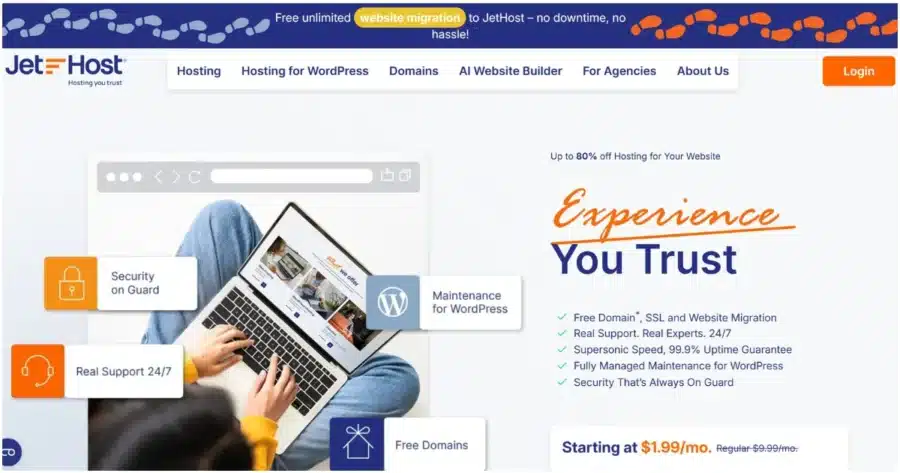
For startups that want direct human support, managed WordPress (WP) tools and room to expand, JetHost provides the strongest overall balance.
JetHost is our choice for the best hosting for WordPress for startups because its WP Maverick plan combines a reasonable entry price with strong capacity and WordPress-specific management tools.
The plan costs $5.99/month initially and renews at $21.99/month. It supports up to 100 websites, 90,000 monthly visits, and 75GB of Cloud NVMe storage. Unlimited traffic and unlimited email accounts are included.
Its WordPress Manager covers updates, staging, backups, and built-in WordPress security tools. Dedicated Patchstack protection is available as a paid add-on on WP Maverick.
These features suit startups that need to launch without a systems administrator. The 100-website allowance also leaves room for product pages, documentation, and campaign landing pages.
JetHost includes free migration handled by its own team. That reduces the technical work required when moving an existing website and makes the plan more practical for hosting for startup WordPress websites.
And last, but not least, JetHost offers an AI Connector that securely links assistants such as ChatGPT, Claude, and Cursor to your hosting account. You can check services, domains, invoices, email, and traffic using a familiar chat interface and simple prompts.
Potential limitations to keep in mind
If your company plans to manage more than 100 websites, it will eventually need the higher-tier plan—WP Business.
JetHost is also a newer player in the hosting market, so startups that place heavy weight on a long public operating history might prefer a more established brand.
Give your startup reliable hosting, direct human support, and enough room to grow.
2. Hostinger: Best for Bootstrapped and Pre-Revenue Startups
Hostinger is best for founders who prioritize low entry cost, multiple websites, and straightforward WordPress tools.
Hostinger’s Unlimited plan works well for startups testing ideas or launching a small website without spending much. It provides affordable hosting for WordPress for startups with several useful tools included.
The plan starts at $4.99/month and renews at $16.99/month. It supports unlimited websites and includes 50GB of NVMe storage, daily backups, staging, an AI website builder, an AI troubleshooting agent, and unlimited mailboxes per website free for the first year.
For a pre-revenue startup, the low starting price keeps costs under control. Unlimited websites allow founders to test landing pages and product concepts without separate hosting accounts. Daily backups and staging also support frequent changes.
Hostinger is a hosting provider with 24/7 support. Its AI tools help resolve common website issues before a support request is needed, although founders should still confirm which support channels are included with the featured tier.
When Hostinger may not be the best fit
The main limitation of Hostinger’s Unlimited plan is the increase from the introductory price to the renewal rate. Startups should budget using the $16.99 monthly renewal price rather than assuming the promotional rate will continue.
Founders attracted by Hostinger’s entry price but looking for different support, limits, or renewal terms can compare the best Hostinger alternatives.
3. SiteGround: Best for Startups Prioritizing Reliability
SiteGround is best for startups that value established infrastructure, WordPress-specific caching and backup tools more than the lowest long-term cost.
SiteGround’s GrowBig plan is suitable for startups willing to pay more for an established WordPress platform and Google Cloud infrastructure. It provides scalable WP hosting for startups that expect to manage several websites under one account.
GrowBig starts at $4.99/month and renews at $29.99/month. It supports unlimited websites and includes 50GB of Premium Google SSD storage, daily backups, on-demand restore points, and a custom caching layer.
Unlimited websites suit a company operating a main site, blog, documentation portal, and campaign sites. Daily backups and restore points provide a safety net when plugin updates or design changes cause issues.
When SiteGround may not be the best fit
The biggest consideration with SiteGround is the renewal price. At $29.99/month, GrowBig becomes one of the more expensive plans in this comparison after the introductory period.
Its 50GB storage limit is also lower than JetHost’s 75GB, despite the higher renewal price. Startups expecting to store large media libraries should compare those limits carefully.
4. Bluehost: Best for First-Time and Non-Technical Founders
Bluehost is best for non-technical founders who value familiar onboarding, phone support, and a clear traffic allowance.
Bluehost’s Business plan is a practical choice for hosting for early-stage WordPress websites when the person managing the site has limited server experience.
The plan starts at $7.99/month and renews at $15.99/month. It supports up to 50 websites, includes 50GB of NVMe SSD storage, and allows up to 200,000 monthly visits. One-click WordPress installation, staging, and phone support are included.
For a first-time founder, the main advantage is simplicity. Phone support provides direct help during a launch or urgent problem. NVMe storage and the stated visit allowance also support fast hosting for a startup expecting high traffic.
Who may want to consider alternatives?
Bluehost’s Business plan allows up to 50 websites, which is fewer than the limits offered by the comparable startup plans from JetHost, Hostinger, and SiteGround. A startup planning a large portfolio of campaign or regional sites can reach that limit sooner.
Technical teams that want more control over performance settings should check the exact plan restrictions.
To compare Bluehost with other beginner-friendly providers, read our guide to the best Bluehost alternatives.
5. DreamHost: Best for Growing Startups Managing Several Sites

DreamHost is best for cost-conscious startups that want several websites, staging, backups, and developer access at a relatively low renewal price.
DreamHost’s Growth plan combines the lowest renewal price in this comparison with capacity for 50 websites and up to 200,000 monthly visits. It offers scalable hosting for WordPress for growing startups that need more room than a basic single-site plan.
The plan starts at $3.99/month and renews at $12.99/month. It includes 50GB of NVMe SSD storage, unmetered bandwidth, automated daily backups, and one-click staging. PHP version control and SSH access are available on request.
These features provide room for a main site, blog, documentation, and campaign pages. Automated backups and staging make frequent updates safer, while developer access gives technical teams more control.
DreamHost is also well suited to hosting for WordPress startup websites when long-term price matters more than premium positioning. Its renewal rate is lower than every other featured plan in this comparison.
When another hosting provider might make more sense
DreamHost’s Growth plan is capped at 50 websites and 50GB of storage. Companies expecting a large portfolio or a substantial media library need another tier or provider.
The 200,000-visit allowance is generous for many early-stage companies, but startups approaching it must confirm how the host measures traffic and what happens after you exceed the limit
6. Kinsta: Best Premium Option for Funded SaaS Startups
Kinsta is best for funded startups that can justify premium managed hosting and do not need a large number of websites on the entry plan.
It’s a good fit for companies that treat hosting for WordPress as managed infrastructure rather than a basic website expense.
The Single Sites plan is free for the first month and then costs $30/month. It supports one website, 35,000 monthly visits, and 10GB of storage. All Kinsta WordPress plans include cloud-based infrastructure, an integrated CDN, free staging, automated daily backups, and built-in analytics.
Kinsta also offers a Multiple Sites plan for two websites and 70,000 monthly visits. It includes 20 GB of storage and costs $59/month after the free first month.
Managed tools and specialist WordPress support create a high-performance hosting package. Kinsta can suit hosting for WordPress company websites used for SaaS marketing, investor communication, and enterprise sales.
Considerations before choosing Kinsta
Kinsta is considerably more expensive than the other WordPress plans on this list. Its entry plan supports only one website and 10GB of storage.
The plans also use monthly visit limits, and overage charges apply. Startups with unpredictable traffic should review the current overage policy carefully.
7. HostGator: Best for Startups Operating Multiple Early Websites
HostGator is best for founders who want several websites, phone and chat support, backups, and a familiar shared-hosting structure.
HostGator’s Business plan works well for companies managing several websites under one account. It suits hosting for WordPress business websites when a startup needs a main company site, a blog, campaign pages, and several smaller properties.
The plan starts at $6.25/month and renews at $21.99/month. It supports up to 50 websites and includes 50GB of SSD storage, unmetered bandwidth, SSL, and 24-hour phone and chat support. A free domain is included for the first year on billing terms of 12 months or longer.
HostGator also includes hosting with automatic backups. The 50-site allowance supports several campaigns and early properties under one plan.
Who should consider a HostGator alternative?
HostGator’s introductory discount is temporary, so founders should compare the plan using the $21.99 renewal price. Storage is also limited to 50GB, while JetHost offers 75GB at the featured tier.
The 50-website cap can become restrictive for a company managing a larger portfolio. Startups should also confirm how many free migrations are included and whether email migration is covered.
Founders comparing HostGator with more flexible options can explore our guide to the best HostGator alternatives.
Factors to Consider When Picking WordPress Website Hosting for Startups
The right WP host should fit the startup’s current stage while leaving enough capacity for its next phase. The following points are the most important to compare:
Uptime and page speed
Look for reliable WP hosting supported by a published uptime commitment. Speed features include NVMe or SSD storage, caching, and a CDN; confirm whether they are included or require an upgrade.
Storage, website and traffic limits
Compare the website allowance, storage and traffic rules. Monthly visits, unmetered traffic and bandwidth are not equivalent, so check how usage is measured, whether overage fees apply and what happens at the limit.
Security, backups and staging
At a minimum, secure hosting for WordPress should include SSL and regular backups. Malware scanning, patch management, and restore points add protection. Staging lets teams test changes before a broken plugin or form affects the live site.
Support and management
Check whether support is available by phone, chat, or ticket. For a non-technical company, managed hosting with WordPress-specific tools and real agents justifies a higher price by reducing troubleshooting.
Email and migration
Confirm mailbox limits, storage, and renewal costs. JetHost includes free team-managed migration; for other providers, check whether migration is technician-assisted or plugin-based, how many sites qualify, and whether email is transferred.
Is your startup hosted on Weebly? The platform is shutting down in 67 countries in December 2026, so explore these Weebly alternatives to find a new home for your website.
Conclusion
The best hosting provider for your startup comes down to your budget, technical capacity, and expected growth.
JetHost remains our overall recommendation for WordPress website hosting for startups. Its WP Maverick plan combines all the features suitable for a startup without a dedicated technical department while still providing room for new products and websites.
Give your startup a faster, easier-to-manage WordPress foundation with the support and flexibility to grow.
JetHost offers unbeatable rates on domain registration, transfers, and renewals.
Frequently Asked Questions
How much does hosting for new WordPress websites cost?
The introductory prices in this comparison range from $3.99/month for DreamHost to $30/month after Kinsta’s free first month.
Several startups can begin with a plan costing between $5 and $10/month during the introductory period. However, founders should plan their budgets using the renewal price and total amount charged at checkout.
Can a startup migrate an existing WordPress website for free?
Yes, it can, but you must check the provider’s offer first. JetHost includes free migration handled by its own team. Other providers offer assisted migration, automated migration plugins, or a limited number of free transfers. Before choosing a provider, confirm how many websites can be moved, whether a technician performs the migration, and whether email accounts are included.
What happens when startup website traffic increases?
Some WP hosting providers publish monthly visit allowances, while others use bandwidth, traffic, or internal resource limits. These measurements are not always directly comparable.
Good hosting for WordPress for startups must offer a clear path to a higher plan. Check what happens when the site reaches its allowance and whether the provider applies overage charges.
Is email included with hosting for WordPress?
Yes, some hosting providers include email in their packages. For example, JetHost includes unlimited email accounts, while Hostinger includes five mailboxes/website free for the first year.
Check the number of mailboxes, storage/account, renewal conditions, and whether email migration is available before purchasing.
Should a startup use shared or managed hosting for WordPress?
Shared hosting can be sufficient for an early prototype or simple company website. Managed hosting for WordPress adds features such as updates, backups, staging, caching, and WordPress-specific security tools.
The right startup website hosting option depends on how much technical work the team can manage internally.
Which WP hosting provider offers the lowest long-term price?
Based on the prices listed here, DreamHost has the lowest renewal rate at $12.99/month. Hostinger provides affordable hosting at the introductory stage, but its featured plan renews at $16.99/month.
Founders should compare renewal pricing, plan limits, and included tools rather than choosing solely on the initial promotion.


Top articles
Our Picks
- 6 minutes read
7 Signs It’s Time to Switch Your Web Hosting Provider
Most people don’t think about their hosting until something breaks. But if your website has been acting up – slower pages, random errors, or unreliable support – it might be…
- 4 minutes read
eDesign Interactive on Pressure, People & Creativity
Client: George, CEO of eDesign Interactive Industry: Web Design, Digital Strategy & Interactive Marketing Website: edesigninteractive.com Relationship: Long-time collaboration with the team behind JetHost
- 2 minutes read
Case Study: How SEO Rush Got 5x Faster with JetHost
Client: SEORUSH Industry: SEO & Digital Marketing Website: seorush.org Service: JetHost WordPress Hosting When you run an SEO agency, your website needs to perform as well as the results you…
Related Posts
 10 minutes read
What Is the Best Hosting for WordPress With Free Migration: 8 Top Providers
Compare 8 WordPress hosting providers offering free website migration, including JetHost, Hostinger, SiteGround, Bluehost, and more. Explore migration methods, pricing, email transfers, and what’s included to find the right host…

- 12 minutes read
6 Fastest Hosting for WordPress Compared in 2026
Looking for the fastest hosting for WordPress in 2026? We compare six leading providers—JetHost, Cloudways, Kinsta, Hostinger, Rocket.net, and Bluehost—exploring their performance features, pricing, caching technologies, and infrastructure to help…
- 13 minutes read
Hosting for WordPress for Web Designers: 6 Providers That Keep Client Sites Fast
The best hosting for WordPress for web designers is JetHost, Hostinger, and SiteGround, followed by Bluehost, DreamHost, and HostGator. Your web designer portfolio does more than showcase your work. It…